|
| |

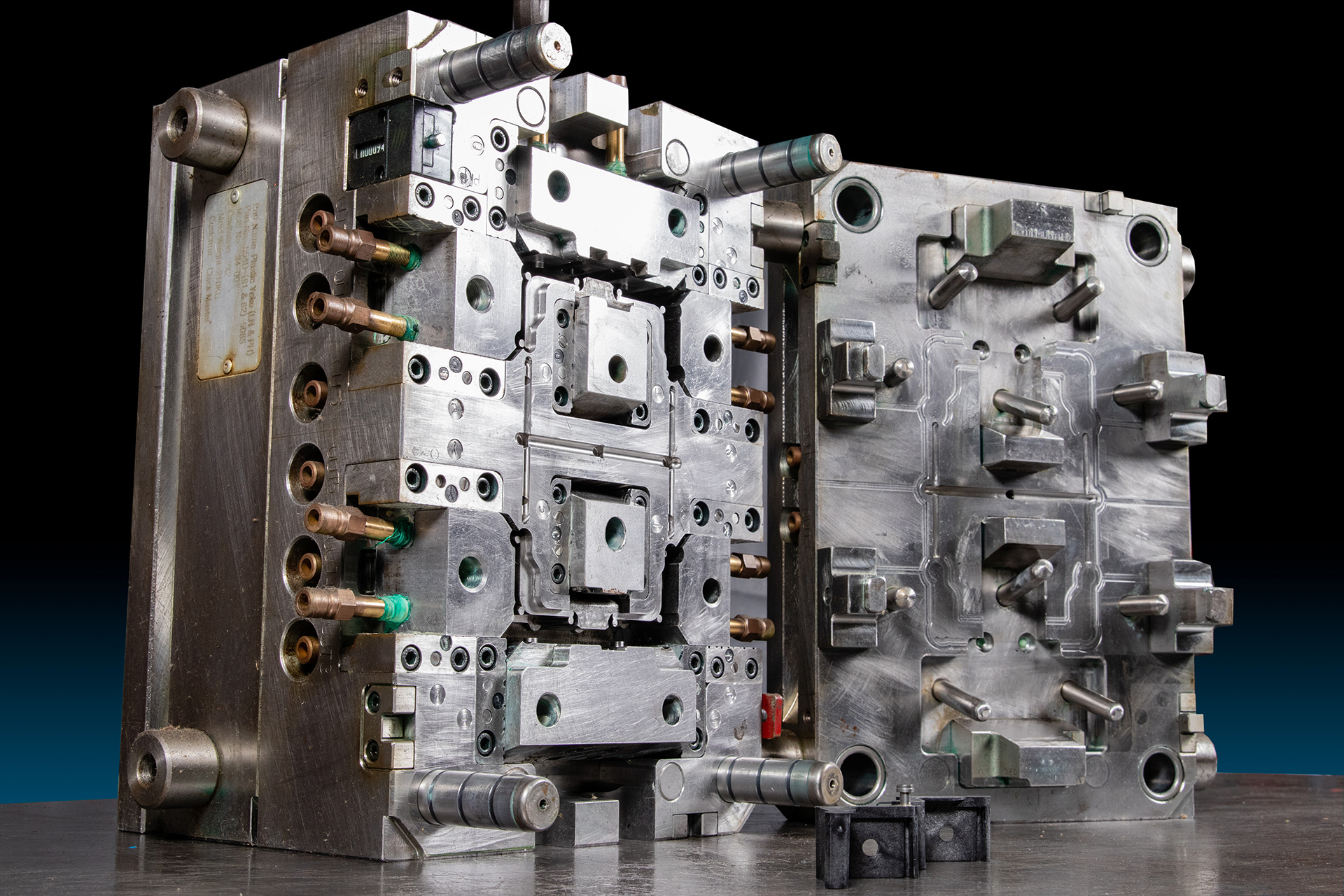
Progressive Molding Technologies can run your existing tooling, or manage
the build of your new tooling through one of our mold-building partners.
Whether a new mold is built by the customer or we manage the build, we
welcome the opportunity to work with our customers early in the design
stages to ensure that the tooling and production process meets their unique
requirements.
We strive to meet all of your requirements for injection molds.
This includes :
 |
Consulting services for
mold type, construction, and cavitation optimization.
|
 |
Mold flow analysis.
|
 |
Single cavity prototype
tooling in aluminum or tool steel.
|
 |
Multi-cavity production
molds.
|
 |
Mold repair and
troubleshooting.
|
|
Types of Injection Molds and Terminology:
At Progressive we can help you to match the appropriate mold type with
your budget or production requirements.
 |
S.P.I.: Class I
Mold: The Society of the Plastics Industry has
developed standards for classifying types of plastic injection molds by
their construction. A typical Class I tool is designed for one
million cycles. Typical characteristics:
 |
Multiple cavity and core inserts.
This allows for quick repair of an individual cavity. |
 |
Hardened cavity and core inserts for wear
resistance. |
 |
Parting line locks for precise alignment of
the mold halves. |
 |
Guided ejection, to reduce wear on the
ejector pins and inserts. |
|
 |
Cold Runner
Injection Mold: The majority of plastic
injection molds built are of the cold runner type. In a cold runner
mold, the plastic melt is injected into the mold through a sprue and
runner where it enters each cavity in the mold. During the cooling
stage of the injection molding cycle, the plastic in the cavities, sprue
and runner solidify. The sprue and runner become scrap in this type
of injection mold. They are then ground into small pieces or pellets
and mixed with the virgin plastic for reuse. Cold runner injection
molds are more economical to build than hot runner molds, however they can
be less economical to run if the amount of plastic in the sprue and runner
exceeds 35% of the plastic that is injected into the part cavities. |
 |
Hot Runner
Injection Mold: A Hot Runner mold
uses a heated manifold and sprue bushing to inject the plastic melt
directly to the part cavity through a heated nozzle. The advantage
of a hot runner mold is that the sprue and runner remain molten, producing
no byproducts to be separated or reground. In addition the cycle
time is often shortened because the amount of plastic to be melted and
then cooled is often drastically reduced. While hot runner molds are
typically more expensive than a conventional cold runner tool, they are
particularly advantageous for small injection molded parts where the sprue
and runner can consist of more than 50% of the total plastic shot per
cycle. |
 |
Three Plate
Injection Mold: A Three plate injection consists of three
major components; the runner plate (which is mounted on the stationary
platen) contains the sprue and half of the runner geometry, the moveable
plate (mounted to the moving platen) contains the ejector system and half
the plastic part geometry, and the floating plate (moves freely between
the stationary and moveable plates) which contains the other half of the
runner geometry and half of the part geometry. As the mold opens, the
floating plate and moveable plate remain together, releasing the sprue and
runner, while de-gating the plastic part. As the mold continues to
open, the floating plate and moveable plate seperate so the plastic parts
can be ejected. The advantage of a three plate mold is that it
allows precise pinpoint or center gating of the plastic parts.
This style mold is generally generally less expensive than a similar
hot runner injection mold. |
 |
Cavity Set:
For short run production or prototyping,
it is often advantageous to build a cavity set to fit into a standard
prototype mold base. A cavity set generally consists of a single
cavity and core insert. The advantage of building a cavity set is
short lead time, and low build cost. A cavity set can be used to
produce prototype parts, or short run production parts. |
|
|
|